Sunday, March 27, 2022

1108. Defanging an IP Address

 Given a valid (IPv4) IP address, return a defanged version of that IP address.

defanged IP address replaces every period "." with "[.]".


Example 1:

Input: address = "1.1.1.1"
Output: "1[.]1[.]1[.]1"

Example 2:

Input: address = "255.100.50.0"
Output: "255[.]100[.]50[.]0"


Constraints:

  • The given address is a valid IPv4 address.
Soluation:

In JS:

var defangIPaddr = function(address) {
    return address.split('.').join('[.]');
};

1816. Truncate Sentence

 A sentence is a list of words that are separated by a single space with no leading or trailing spaces. Each of the words consists of only uppercase and lowercase English letters (no punctuation).

  • For example, "Hello World""HELLO", and "hello world hello world" are all sentences.

You are given a sentence s​​​​​​ and an integer k​​​​​​. You want to truncate s​​​​​​ such that it contains only the first k​​​​​​ words. Return s​​​​​​ after truncating it.


Example 1:

Input: s = "Hello how are you Contestant", k = 4
Output: "Hello how are you"
Explanation:
The words in s are ["Hello", "how" "are", "you", "Contestant"].
The first 4 words are ["Hello", "how", "are", "you"].
Hence, you should return "Hello how are you".

Example 2:

Input: s = "What is the solution to this problem", k = 4
Output: "What is the solution"
Explanation:
The words in s are ["What", "is" "the", "solution", "to", "this", "problem"].
The first 4 words are ["What", "is", "the", "solution"].
Hence, you should return "What is the solution".

Example 3:

Input: s = "chopper is not a tanuki", k = 5
Output: "chopper is not a tanuki"


Constraints:

  • 1 <= s.length <= 500
  • k is in the range [1, the number of words in s].
  • s consist of only lowercase and uppercase English letters and spaces.
  • The words in s are separated by a single space.
  • There are no leading or trailing spaces.
Soluation:

In JS:

var truncateSentence = function(s, k) {
    let result = [];
      for(let i=0; i<k; i++){
        let n = s.split(" ");
        result[i] = n[i];
      }
    return result.join(" ");
};

1528. Shuffle String

 You are given a string s and an integer array indices of the same length. The string s will be shuffled such that the character at the ith position moves to indices[i] in the shuffled string.

Return the shuffled string.


Example 1:

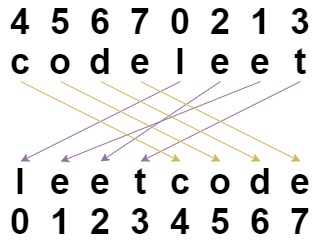
Input: s = "codeleet", indices = [4,5,6,7,0,2,1,3]
Output: "leetcode"
Explanation: As shown, "codeleet" becomes "leetcode" after shuffling.

Example 2:

Input: s = "abc", indices = [0,1,2]
Output: "abc"
Explanation: After shuffling, each character remains in its position.


Constraints:

  • s.length == indices.length == n
  • 1 <= n <= 100
  • s consists of only lowercase English letters.
  • 0 <= indices[i] < n
  • All values of indices are unique.
Soluation:

In JS:

var restoreString = function(s, indices) {    
     const arr = new Array(indices.length);
    for(let i=0;i<indices.length;i++){
        arr[indices[i]] = s[i] 
    }
    return arr.join('');
};

1768. Merge Strings Alternately

 You are given two strings word1 and word2. Merge the strings by adding letters in alternating order, starting with word1. If a string is longer than the other, append the additional letters onto the end of the merged string.

Return the merged string.


Example 1:

Input: word1 = "abc", word2 = "pqr"
Output: "apbqcr"
Explanation: The merged string will be merged as so:
word1:  a   b   c
word2:    p   q   r
merged: a p b q c r

Example 2:

Input: word1 = "ab", word2 = "pqrs"
Output: "apbqrs"
Explanation: Notice that as word2 is longer, "rs" is appended to the end.
word1:  a   b 
word2:    p   q   r   s
merged: a p b q   r   s

Example 3:

Input: word1 = "abcd", word2 = "pq"
Output: "apbqcd"
Explanation: Notice that as word1 is longer, "cd" is appended to the end.
word1:  a   b   c   d
word2:    p   q 
merged: a p b q c   d


Constraints:

  • 1 <= word1.length, word2.length <= 100
  • word1 and word2 consist of lowercase English letters.
Soluation:

In JS:

var mergeAlternately = function(word1, word2) {
     let result = ""
    
    let i = 0

    while(i < word1.length || i < word2.length){
        result += word1[i] !== undefined ? word1[i] : ""
        result += word2[i] !== undefined ? word2[i] : ""
        i++
    }
    return result;
};

709. To Lower Case

 Given a string s, return the string after replacing every uppercase letter with the same lowercase letter.


Example 1:

Input: s = "Hello"
Output: "hello"

Example 2:

Input: s = "here"
Output: "here"

Example 3:

Input: s = "LOVELY"
Output: "lovely"


Constraints:

  • 1 <= s.length <= 100
  • s consists of printable ASCII characters.
Soluation:

In JS:

var toLowerCase = function(s) {
    let result = s.toLowerCase();
    return result;
};

1588. Sum of All Odd Length Subarrays

 Given an array of positive integers arr, calculate the sum of all possible odd-length subarrays.

A subarray is a contiguous subsequence of the array.

Return the sum of all odd-length subarrays of arr.


Example 1:

Input: arr = [1,4,2,5,3]
Output: 58
Explanation: The odd-length subarrays of arr and their sums are:
[1] = 1
[4] = 4
[2] = 2
[5] = 5
[3] = 3
[1,4,2] = 7
[4,2,5] = 11
[2,5,3] = 10
[1,4,2,5,3] = 15
If we add all these together we get 1 + 4 + 2 + 5 + 3 + 7 + 11 + 10 + 15 = 58

Example 2:

Input: arr = [1,2]
Output: 3
Explanation: There are only 2 subarrays of odd length, [1] and [2]. Their sum is 3.

Example 3:

Input: arr = [10,11,12]
Output: 66


Constraints:

  • 1 <= arr.length <= 100
  • 1 <= arr[i] <= 1000
Soluation:

In JS:

var sumOddLengthSubarrays = function(arr) {
    let  s = 0;
  for(let i = 0;i<arr.length;i++){
      let sum = 0;
      let e = 0;
      for(let j = i;j<arr.length;j++){
          e++;
          sum += arr[j];
          if((e)%2 != 0)
              s += sum;      
      }
  }
return s;
};

1790. Check if One String Swap Can Make Strings Equal

 You are given two strings s1 and s2 of equal length. A string swap is an operation where you choose two indices in a string (not necessarily different) and swap the characters at these indices.

Return true if it is possible to make both strings equal by performing at most one string swap on exactly one of the strings. Otherwise, return false.


Example 1:

Input: s1 = "bank", s2 = "kanb"
Output: true
Explanation: For example, swap the first character with the last character of s2 to make "bank".

Example 2:

Input: s1 = "attack", s2 = "defend"
Output: false
Explanation: It is impossible to make them equal with one string swap.

Example 3:

Input: s1 = "kelb", s2 = "kelb"
Output: true
Explanation: The two strings are already equal, so no string swap operation is required.


Constraints:

  • 1 <= s1.length, s2.length <= 100
  • s1.length == s2.length
  • s1 and s2 consist of only lowercase English letters.

Soluation:

In Javascript:

var areAlmostEqual = function(s1, s2) {
    let a = 0;

      if (s1 === s2) {
        return true;
      }

      for (let i = 0; i < s1.length; i++) {
        if (s1[i] !== s2[i]) {
          a++;
        }
        if (!s2.includes(s1[i])) {
          return false;
        }
      }
      return a === 2; 
};

1720. Decode XORed Array

 There is a hidden integer array arr that consists of n non-negative integers.

It was encoded into another integer array encoded of length n - 1, such that encoded[i] = arr[i] XOR arr[i + 1]. For example, if arr = [1,0,2,1], then encoded = [1,2,3].

You are given the encoded array. You are also given an integer first, that is the first element of arr, i.e. arr[0].

Return the original array arr. It can be proved that the answer exists and is unique.


Example 1:

Input: encoded = [1,2,3], first = 1
Output: [1,0,2,1]
Explanation: If arr = [1,0,2,1], then first = 1 and encoded = [1 XOR 0, 0 XOR 2, 2 XOR 1] = [1,2,3]

Example 2:

Input: encoded = [6,2,7,3], first = 4
Output: [4,2,0,7,4]


Constraints:

  • 2 <= n <= 104
  • encoded.length == n - 1
  • 0 <= encoded[i] <= 105
  • 0 <= first <= 105

Soluation:


In Javascript:

var decode = function(encoded, first) {
    let newArray = [],  temp=0;
    newArray.push(first);
    for(let i=0; i<encoded.length; i++){
      let value = newArray[temp] ^ encoded[i];
       newArray.push(value);
       temp++;
    }
    return newArray;
};

Wednesday, March 23, 2022

1470. Shuffle the Array

 Given the array nums consisting of 2n elements in the form [x1,x2,...,xn,y1,y2,...,yn].

Return the array in the form [x1,y1,x2,y2,...,xn,yn].


Example 1:

Input: nums = [2,5,1,3,4,7], n = 3
Output: [2,3,5,4,1,7] 
Explanation: Since x1=2, x2=5, x3=1, y1=3, y2=4, y3=7 then the answer is [2,3,5,4,1,7].

Example 2:

Input: nums = [1,2,3,4,4,3,2,1], n = 4
Output: [1,4,2,3,3,2,4,1]

Example 3:

Input: nums = [1,1,2,2], n = 2
Output: [1,2,1,2]


Constraints:

  • 1 <= n <= 500
  • nums.length == 2n
  • 1 <= nums[i] <= 10^3

Soluation:

In JS:

var shuffle = function(nums, n) {
    let temp = n;
    let newArray = [];
    for(let index=0; index<n; index++){
        newArray.push(nums[index]);
        newArray.push(nums[temp]);
        temp++;
    }
    return newArray;
};